Delegating Projects: Accountability Without Control
You become an engineering manager and suddenly you’re accountable for projects you don’t execute. The work sits with a senior or staff engineer. They have deep context. Strong opinions. Often more technical expertise than you.
Your instinct is to stay close. Their instinct is to run. That tension is where most delegation failures happen.
I’ve spent the last year figuring out where the line is. Not from a textbook. From doing it wrong, adjusting, and slowly finding what works.
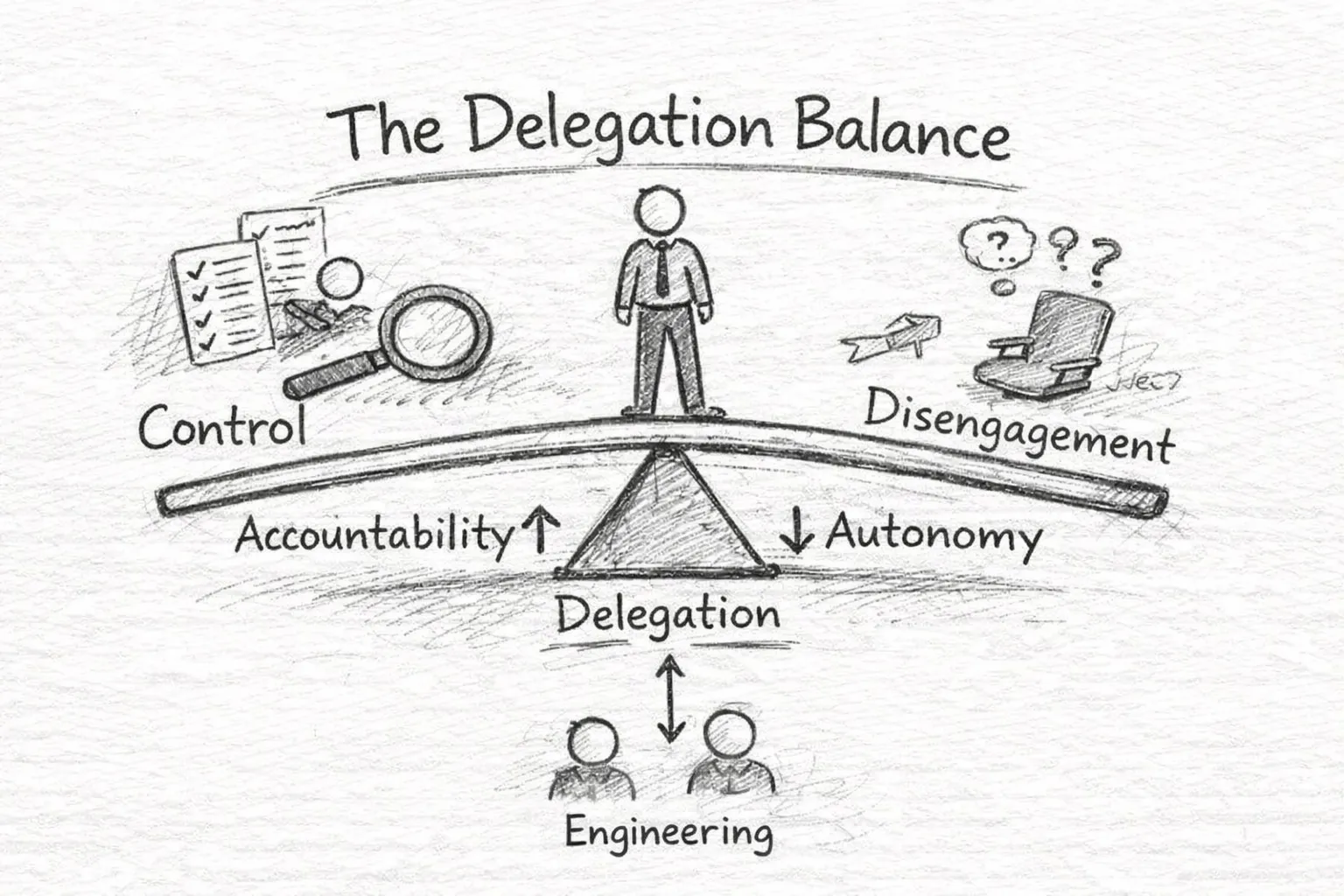
The delegation tension
There are two ways delegation goes wrong.
The first is over-control.
You ask for daily updates, review every PR, sit in every meeting. The engineer feels watched. Their ownership erodes. You end up doing the thinking for them, which is exactly what you were trying to avoid.
The second is under-involvement.
You hand off the project, check in occasionally, and assume no news is good news. Then your boss asks for a status update and you have nothing. Or worse, you discover a risk three weeks after it appeared.
Neither of these is delegation. One is micromanagement. The other is stepping back too far and calling it trust.
Real delegation lives in the uncomfortable middle: accountability upward, autonomy downward.
This isn’t about staying close or staying out of the way. It’s about structure.
You are accountable to leadership for outcomes. The engineer is autonomous in how they get there. Your job is to hold that boundary without collapsing into either extreme.
The ownership split
The clearest thing I did was define the ownership split. Not in a document but in a conversation.
The engineer owns
- Technical execution and architecture decisions within agreed scope
- Day-to-day delivery and sequencing
- Communicating progress to the team
The EM owns
- Translating business context to leadership
- Detecting risks early and deciding when to escalate
- Removing organizational blockers
- Holding accountability upward without absorbing the work downward
The contract between us came down to four questions I needed answered on a regular cadence:
- What shipped since last time?
- What’s coming next?
- What’s at risk?
- What needs my help?
That’s it.
Not a status report. A conversation.
Fifteen minutes, once a week. Enough signal for me to stay informed and represent the project upward. Enough space for them to own execution completely.
This scales with seniority. With a junior engineer, you delegate tasks. With a senior engineer, you delegate outcomes. With a staff engineer, you delegate problem spaces. The model stays the same. The depth of trust changes.
A simple operating system
I use a simple framework for every delegation decision: frame, delegate, escalate.
It helps because it gives shape to something that often gets handled by instinct.
Frame the work before handing it off. Not the solution. The problem. What’s the context? What are the constraints? What does success look like? What decisions are theirs to make? If you can’t frame it clearly, you’re not ready to delegate it.
Delegate outcomes, not tasks. “Figure out how to make this reliable” is delegation. “Add a retry mechanism to the queue processor” is a task assignment. The difference matters because it tells the engineer what kind of thinking you expect from them. Agree on a lightweight check-in cadence. Weekly for most projects. More often only if risk demands it.
Escalate with structure when things go sideways. The engineer should know what an escalation looks like: here’s the situation, here’s the impact, here are the options, here’s my recommendation, here’s what I need from you. If they can escalate in that shape, you can respond quickly. If they can’t, help them practice. It’s a skill, not an instinct.
What this looked like
I managed a project where the engineer had context I didn’t. Stronger stakeholder relationships. Better technical intuition in the domain. A clearer architectural point of view.
My instinct was to stay close.
The real work was figuring out what I actually needed to know versus what I wanted to know for comfort.
Work was moving forward, but I didn’t always have clear signal. That was my problem to fix, not their problem to solve by reporting more. So we built the signal together: timelines, milestones, tickets, weekly check-ins. Not because they were doing it wrong. Because we were raising the bar for how the project should run.
The same principle applies again here. Standards are more useful when they emerge from the work than when they arrive as policy.
Real mentoring happened in both directions. They taught me what strong technical ownership looks like when you trust it. I helped create the structure that made their progress visible to leadership.
By the end, they owned execution completely and I could represent the project upward with confidence. No surveillance. No guessing.
In another project, I delegated the design and execution of a recurring operational process to an engineer who had more hands-on experience than I did. My job wasn’t to tell them how to do it. They already knew. My job was to stay available for unblocking and escalation, and to make sure the process had organizational support.
The result was a system that ran without me.
Which is the point.
The hardest lesson was about my own instincts. Early on, I caught myself absorbing decisions, not because the team couldn’t make them, but because I wanted to be sure they were correct.
That’s a trap.
Certainty feels like leadership, but it’s usually a bottleneck.
The shift was learning to ask “What am I missing?” instead of “Let me verify this.”
Faster decisions. Stronger ownership. Less of me in the critical path.
Try this next week
If you’re delegating a project to a senior or staff engineer this week, try this in your next 1:1:
- Here’s the problem and context (Frame)
- Here’s what I need from you: scope, milestones, top risks (the contract)
- Here’s what’s yours to decide, and here’s where I need to be in the loop
- Let’s check in weekly. Fifteen minutes. Four questions: shipped, next, risks, help needed
Use this seniority cheat sheet:
| Level | You delegate | They own | Check-in cadence |
|---|---|---|---|
| Junior | Tasks with guardrails | Execution within steps | 2-3x per week |
| Senior | Outcomes with constraints | Execution and sequencing | Weekly |
| Staff | Problem spaces | Execution, architecture, and roadmap within scope | Milestone-level |
Run a weekly checkpoint with four questions:
- What shipped?
- What is next?
- What is at risk?
- What needs escalation?
That’s your entire operating system. Simple enough to remember, structured enough to hold accountability.
The principle
Your job is not to hold the keyboard. Your job is to hold accountability, upward to leadership and sideways to the standards your team is building together.
The best projects I’ve led weren’t the ones where I had the most control. They were the ones where I built the right structure, gave real autonomy, and stayed close enough to see risk without getting so close that I blocked progress.
Delegation is not a single act. It’s a daily practice of choosing trust over comfort, structure over control, and team standards over personal certainty.
If you’re building those standards with your team rather than handing them down, you’re probably on the right path.
About the author: Mirko Borivojevic is Team Lead & Senior Software Engineer at Hygraph, with 15+ years of experience across startups, biotech, and SaaS companies. He writes about engineering leadership at Behind the notebook.